What is included in basic pool maintenance?
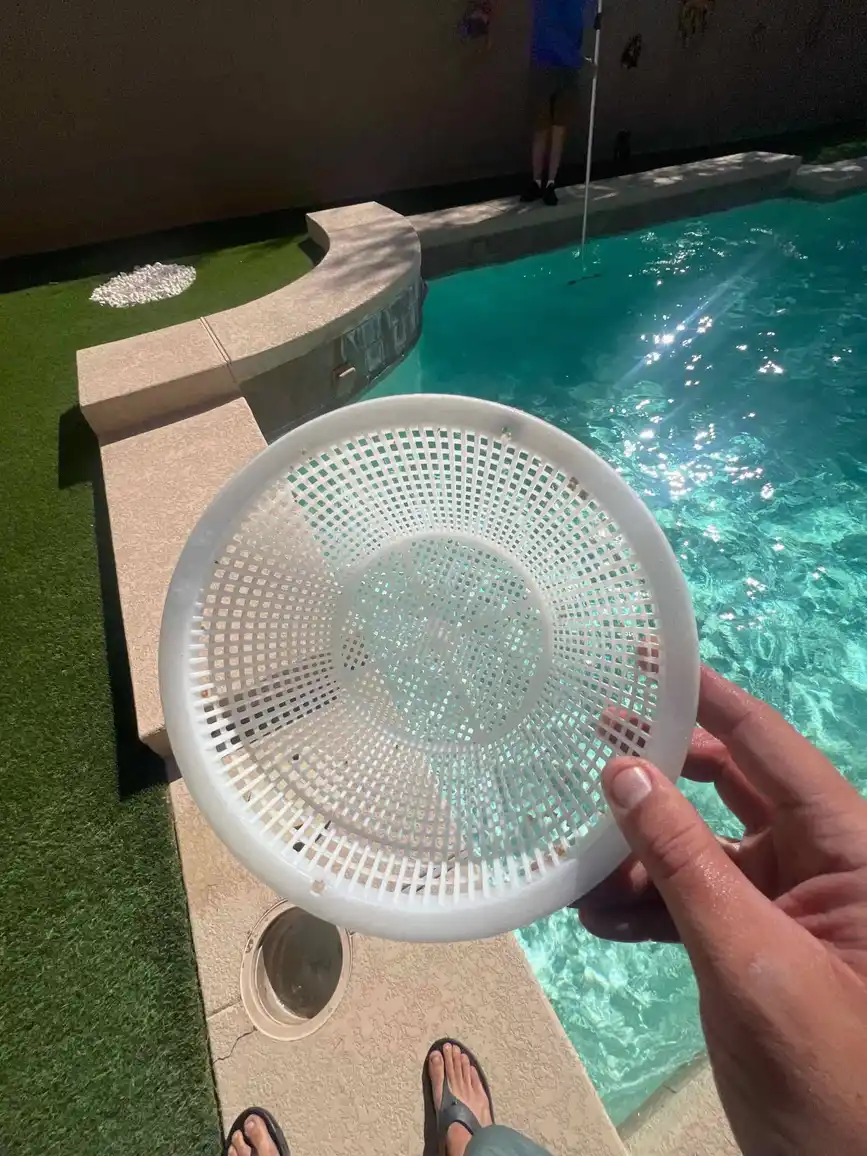
A basic routine has five parts: skim the surface, brush the walls and steps, empty the skimmer and pump baskets, test and adjust the water, and check the equipment. Done on a steady schedule, these keep small problems from turning into green water or a clogged filter.
Skimming and basket cleaning keep leaves and debris from restricting flow to the pump. Brushing keeps algae from getting a foothold on walls, steps and corners. Testing and adjusting the chemistry keeps the water safe to swim in and easier on the surfaces and equipment. A quick look at the pump, filter pressure and any leaks rounds it out.
Blue Kiwi Pools provides basic pool maintenance and basic pool cleaning for homeowners in Mesa and the surrounding Phoenix-area towns.
How often should a pool be maintained?
Plan on a weekly visit to the pool for skimming, brushing, baskets and a water test. The filter needs attention less often, and deeper jobs happen a few times a year or when something looks off.
In swim season, or after a storm, a windy week or a pool party, it helps to check the water more than once a week. Heavy use and lots of sun use up chlorine faster, so the numbers can drift between tests. In cooler months you can often stretch some tasks, but the pump still needs to run and the water still needs testing.
Skipping a few weeks is usually where trouble starts. Algae can take hold in a matter of days once chlorine runs low.
What should I test for in my pool water?
The core numbers are free chlorine, pH and total alkalinity. Typical target ranges are free chlorine around 1 to 3 ppm, pH between 7.2 and 7.6, and total alkalinity between 80 and 120 ppm.
Two more are worth checking every month or so: cyanuric acid (the chlorine stabilizer, often kept around 30 to 50 ppm) and calcium hardness (commonly 200 to 400 ppm). Phosphates can feed algae, so a phosphate test is useful if the water keeps clouding despite good chlorine.
Adjust one thing at a time and retest after the water has circulated. Changing several chemicals at once makes it hard to tell what worked. Always follow the product label and never mix chemicals together.
How do I clean a pool filter, and how often?
Cartridge and sand or DE filters all need cleaning when the pressure gauge reads roughly 8 to 10 psi above its clean starting number, or when flow looks weak. For many pools that works out to a rinse every few weeks and a deeper cleaning a few times a year.
For a cartridge filter, turn off the pump, pull the cartridge, and rinse between the pleats with a hose. A soak in a cartridge cleaner helps with oils and buildup. Cartridges wear out, and when the pleats are flattened or frayed, cleaning no longer restores flow and the cartridge needs replacing.
A dirty filter makes the pump work harder and lets the water cloud up, so it is one of the most useful regular chores.
Can I do basic pool maintenance myself, or should I hire it out?
Yes, many owners handle weekly maintenance themselves with a test kit, a brush, a skimmer net and a bit of routine. The trade-off is time and consistency: the work is simple, but it has to happen every week, including when you travel or the schedule gets busy.
Doing it yourself makes sense if you enjoy it and can keep up with the testing. Hiring it out makes sense if you want it done on a steady schedule, if the water has gotten away from you, or if you are not sure how to read the test results.
Either way, it helps to know the signs that a pool needs more than the basics, which is the next section.
When does a pool need more than basic maintenance?
If the water is green or cloudy after you have balanced the chemistry, if the pump is loud or losing pressure, or if the heater will not fire, the problem is bigger than routine upkeep.
Green water usually calls for a heavier cleanup rather than a weekly skim. Scaling, stains or a rough surface may point to treatments such as acid washing or tile blasting. Equipment trouble, like a pump that will not prime or a heater that fails, is a repair job, and an equipment inspection or pool diagnostics can narrow down the cause.
Blue Kiwi Pools also offers green to clean pool cleaning, filter cleanings, phosphate treatments, drain and refill, and pool and heater repairs for these larger jobs.
Questions we hear
What is the difference between basic pool cleaning and basic pool maintenance?
Basic pool cleaning is the physical work: skimming, brushing and emptying baskets. Maintenance adds water testing and balancing, filter care and a look at the equipment. Most pools need both to stay clear and running well.
How long should I run my pool pump each day?
A common rule is to circulate the full volume of the pool at least once a day, which often means around 8 hours for a typical residential pool. Pump size, pool size and filter type change that number, so treat it as a starting point and adjust to keep the water clear.
Why does my pool turn green even though I add chlorine?
Green water usually means algae has outpaced the chlorine, often because of low free chlorine, high pH, a dirty filter, poor circulation or phosphates feeding the algae. Brushing, balancing the water and cleaning the filter are the usual first steps. If it does not clear, a heavier cleanup is needed.
Do I need to drain my pool for maintenance?
Not as part of routine care. Draining and refilling is occasionally done when the water chemistry cannot be brought back into range, such as very high stabilizer or dissolved solids, or when a surface treatment requires it. Pool surfaces and local rules on draining vary, so get advice before emptying a pool.
What basic supplies do I need to maintain my own pool?
A test kit or strips, a telescoping pole, skimmer net, wall brush, and the chlorine and pH adjusters your pool uses are the basics. A vacuum head or automatic cleaner and a hose for rinsing the filter are good additions. Store chemicals separately, sealed and out of reach of children.