What tasks make up basic pool maintenance?
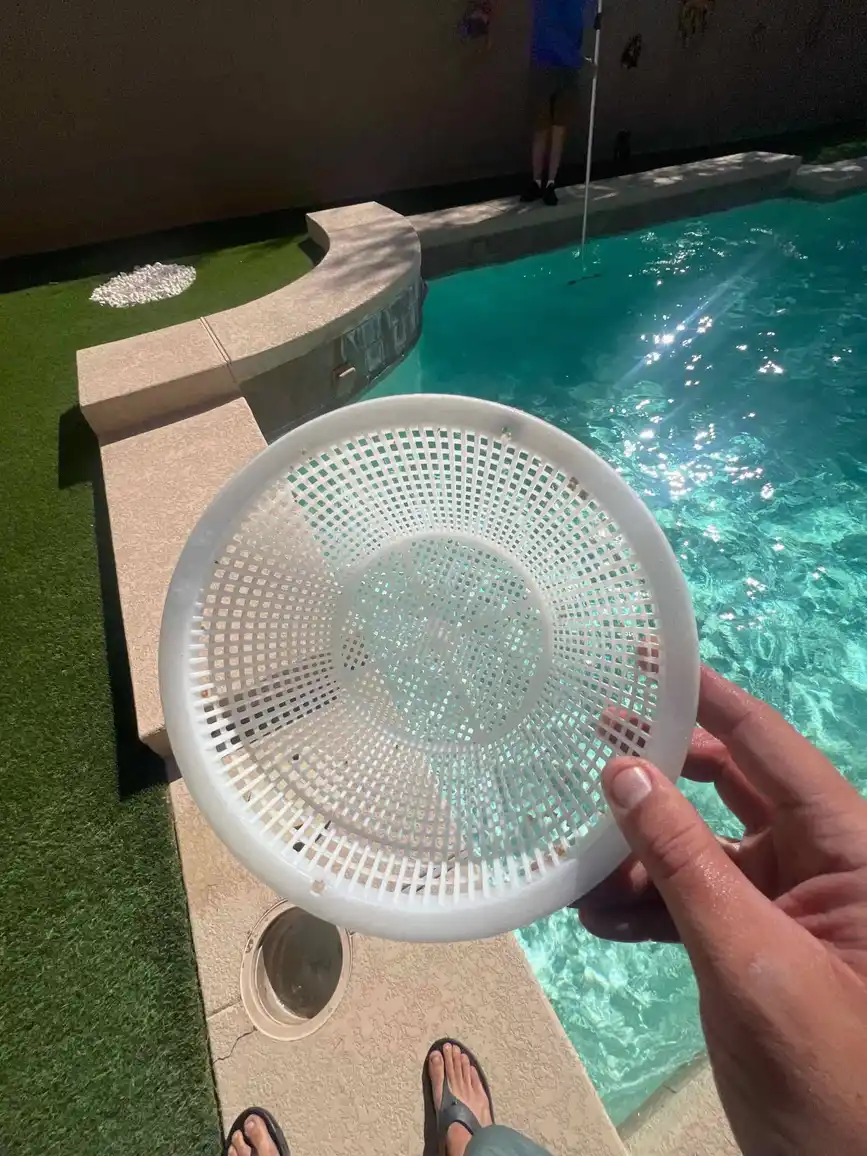
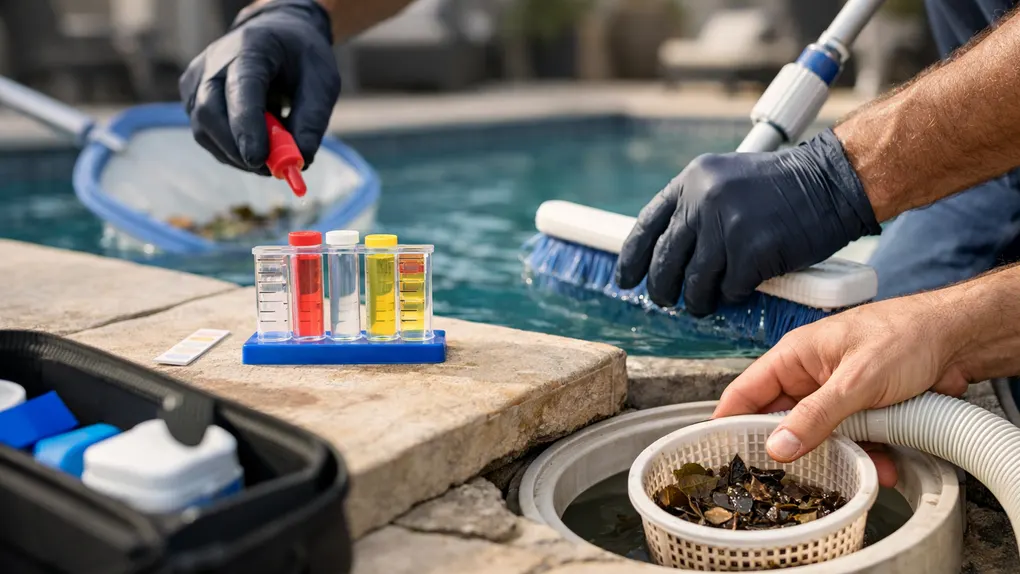
The core tasks are skimming debris off the surface, emptying the skimmer and pump baskets, brushing the walls and steps, vacuuming the floor as needed, testing the water, and adding chemicals to keep it balanced. A quick look at the pump, filter pressure and water level rounds it out.
Skipping any one of these usually shows up later. Unbrushed walls grow algae, full baskets restrict flow, and unbalanced water can cloud up or irritate skin and eyes.
How often should a pool be maintained?
Most pools need attention once a week, with skimming and a basket check more often when leaves, dust or wind blow debris in. Water testing is typically done weekly, and more often after heavy use, storms or very hot stretches.
In hot, sunny desert climates like the Phoenix area, chlorine burns off faster and swimming season is long, so pools often need steady attention nearly year-round rather than only in summer. Winter is lighter work, not no work.
What water chemistry should be checked?
The usual checks are free chlorine, pH, total alkalinity, calcium hardness and stabilizer (cyanuric acid). Typical targets are pH around 7.2 to 7.6, alkalinity around 80 to 120 ppm, and free chlorine of roughly 1 to 3 ppm, though your pool type and equipment may call for different numbers.
Adjust one thing at a time and retest. Fixing alkalinity first usually makes pH easier to hold steady. Phosphates can also feed algae, so a phosphate test is worth doing if the water keeps turning green despite good chlorine levels.
What about the filter and pump?
The filter does the fine cleaning, so it needs its own schedule. Cartridge filters are typically rinsed every few weeks to few months depending on debris and use, and deep cleaned or replaced when rinsing no longer restores flow. Sand and DE filters are backwashed when pressure rises about 8 to 10 psi above its clean reading.
Listen for a pump that is noisy, loses prime, or runs hot, and watch for leaks around fittings. Catching those early is usually cheaper than waiting for a failure.
Should I do it myself or hire a pool service?
Doing it yourself costs less in cash but takes weekly time, a test kit, and some learning about chemicals. It works well for people who enjoy it and are consistent. Hiring makes sense if you travel, are short on time, or keep fighting cloudy or green water.
Blue Kiwi Pools is a pool service serving Mesa, Tempe, Phoenix and surrounding Valley communities, offering basic pool maintenance, cleaning, equipment inspection and repairs. Whichever route you choose, the key is consistency: a missed few weeks in hot weather can turn into a green pool that needs a much bigger cleanup.
Questions we hear
Is basic pool maintenance the same as pool cleaning?
They overlap but are not identical. Cleaning is the physical work of skimming, brushing and vacuuming, while maintenance adds water testing, chemical balancing, and checking the filter and pump. Maintenance keeps the pool healthy, and cleaning keeps it looking good.
How much time does weekly pool maintenance take?
A typical residential pool takes about 30 to 60 minutes a week once you have a routine. Pools with lots of nearby trees, heavy use, or neglected water take longer.
What happens if I skip pool maintenance for a few weeks?
In warm weather, chlorine drops, algae can take hold, and the water may turn cloudy or green within days to a couple of weeks. Getting it back usually takes a heavier cleaning, filter work and extra chemicals than regular upkeep would have.
Do pools need maintenance in winter?
Yes, though less. In mild climates the pool still needs circulation, filter care and periodic water testing, because algae and scale can still develop. Run times and chemical doses are usually lower in cooler months.
What equipment should be checked during maintenance?
Check the pump, filter, baskets, skimmer, heater if you have one, and any visible plumbing for leaks. An equipment inspection every so often helps catch worn parts before they fail.